
Results, Mistakes, and Reusable Playbook: The J Luxe Rebuild Retrospective
Part 8 of the J Luxe rebuild series: the real results, most expensive mistakes, and reusable website growth playbook that came out of the full rebuild.

Our articles are written and reviewed in-house using real website launch, redesign, technical SEO, and conversion work. We update posts when our process changes, and we keep the advice aligned with what we actually implement for businesses in Nigeria and remote international markets.
Results, Mistakes, and Reusable Playbook (Part 8)
This is the final part of the J Luxe rebuild series.
It is also the part most teams want first.
Need website design in 48 hours?
If you need a professional website live fast for Nigeria-based or international clients, the launch offer is built for that exact use case.
Explore the full service at website design in 48 hours, see how to launch your website in 48 hours, or review the done-for-you website launch details.
What actually changed?
What worked?
What nearly created avoidable losses?
And what should a small business or agency copy from this rebuild instead of starting from zero?
If you only want the short version, it is this:
- the rebuild worked because strategy, SEO, conversion, architecture, and launch discipline were treated as one system
- the strongest gains came from removing friction, improving performance, and making commercial pages clearer
- the most expensive mistakes were the ones that could have affected every page at once
- the reusable value is not one tactic, but the sequence we used
In the earlier parts of the J Luxe series, we covered the full build path:
- Why We Rebuilt, Not Redesigned (Part 1)
- The Audit That Created the Roadmap (Part 2)
- SEO Migration Without Losing Traffic (Part 3)
- Writing Service Pages That Convert (Part 4)
- Premium Design Without Slow Pages (Part 5)
- Next.js Architecture and Build Decisions (Part 6)
- Launch Week Checklist and First 7 Days (Part 7)
Part 8 is the retrospective.
This is where the case study becomes a reusable website growth playbook.
For the broader before-and-after summary, also see the main J Luxe Medical Aesthetics case study.
What results came out of the rebuild?
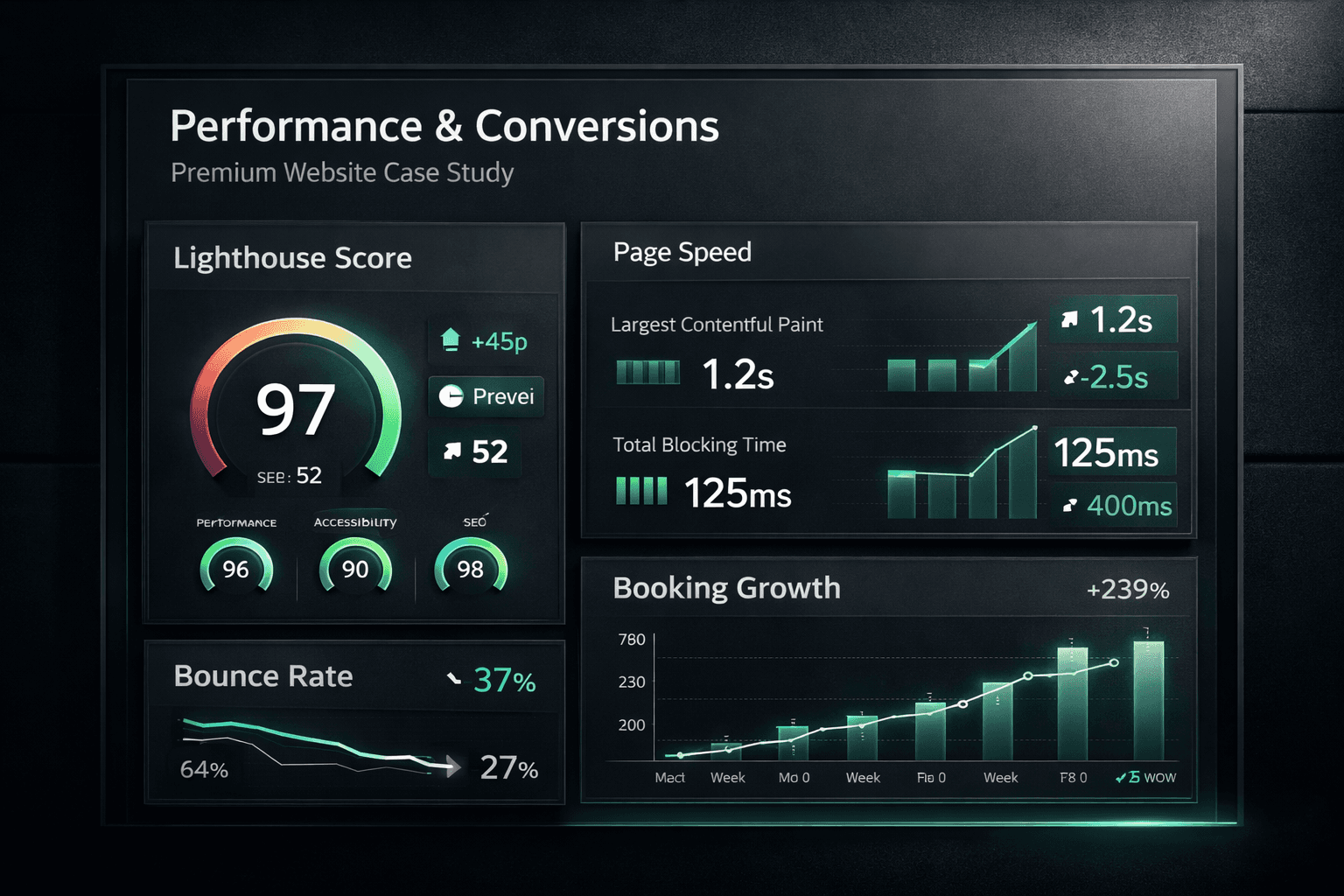
Using the outcomes already documented in the J Luxe case study, the clearest changes were:
- Lighthouse Performance improved from `42` to `100`
- First Contentful Paint improved from `2.8s` to `0.2s`
- mobile bounce rate dropped from `65%` to `35%`
- monthly bookings increased by `25%`
Those numbers matter because they connect technical work to business outcomes.
This was not a redesign where the only win was "the site looks nicer now."
The rebuild improved:
- speed
- trust
- local SEO clarity
- conversion flow
- launch reliability
That combination is why the project performed better.
Why the rebuild produced better outcomes
The results did not come from one magical lever.
They came from stacking several disciplined choices together.
1) We fixed structural problems, not surface-level symptoms
Part 1 mattered because the project was framed correctly from the start.
The old site was not just visually dated.
It had structural issues:
- slow loading
- weak service-page conversion flow
- local SEO gaps
- template trust problems
- technical limitations that made future improvements harder
That is why the decision to rebuild instead of merely redesign was so important.
When the diagnosis is wrong, the project scope is wrong.
2) We used an audit to control what happened next
The audit created prioritization.
Instead of guessing what to fix first, the project moved through:
- page intent
- ranking opportunity
- conversion potential
- implementation effort
That made the work more focused and reduced wasted motion.
If you are planning a similar project, pair this with the broader small business website redesign checklist.
3) We treated SEO and conversion as one job
This is one of the biggest reasons the rebuild worked.
Service pages were not written to "rank first, convert later."
They were built to:
- match search intent
- explain the offer clearly
- reduce hesitation
- move people toward a meaningful next step
That is the kind of structure that works well for both classic search and AI-assisted discovery, because the page can be understood quickly by humans and machines.
4) We protected performance without flattening the brand
Part 5 showed why premium design does not have to mean slow pages.
The rebuild used:
- lighter assets
- cleaner component choices
- mobile-aware design decisions
- stricter performance discipline
That improved both user experience and search performance.
5) We treated launch as an operating phase, not a finish line
The launch system mattered because good work can still be damaged by poor go-live execution.
DNS checks, redirects, canonicals, analytics, and first-week monitoring were part of the build process, not an afterthought.
That is one reason the rebuild held together after launch instead of becoming reactive.
What worked best during the rebuild
If I had to choose the most valuable parts of the project, it would be these five.
1) Clear service-page positioning
The service pages had a stronger job than before.
They were designed to help a visitor answer:
- am I in the right place?
- does this business feel credible?
- does this service solve my problem?
- what should I do next?
That kind of clarity improves conversions and makes commercial pages easier to understand in search results, snippets, and AI summaries.
For businesses trying to improve similar pages, the closest practical reference on this site is the 48-hour website launch page, which shows how a focused offer can stay clear without becoming cluttered.
2) Better local SEO structure
Local visibility improved because the site became more explicit about:
- services
- locations
- page roles
- structured data
- internal linking
This matters more than many small businesses realize.
Local SEO often underperforms because the site does not make business relevance clear enough.
3) Faster, cleaner mobile experience
The performance work did not only help scores.
It reduced friction.
That is a major reason bounce rate improved.
People on mobile do not wait around for a premium brand story to eventually become usable.
They decide quickly.
4) Stronger booking and conversion flow
The rebuild removed unnecessary steps between interest and action.
That is a quiet but high-value improvement.
Teams sometimes overfocus on rankings and underfocus on what happens after the click.
That is how traffic grows while leads stay flat.
If that problem sounds familiar, read Why Your Website Is Not Getting Leads.
5) Reusable systems instead of one-off fixes
The component, metadata, schema, and launch systems mattered because they made quality easier to repeat.
That is the difference between a site that improves over time and a site that decays after launch.
What nearly went wrong
The most expensive mistakes were not flashy.
They were the kind that can quietly create SEO, conversion, or analytics losses if the team is not disciplined.
Mistake 1: underestimating host-level risk
A host-level redirect or canonical mistake can affect every important URL at once.
That is why launch validation has to check:
- apex and `www` behavior
- HTTPS behavior
- canonical output
- redirect behavior on priority URLs
This is one of those problems that can make a technically strong site look broken to search engines.
Mistake 2: assuming publishing quality will stay consistent on its own
It will not.
Without reusable patterns, service pages drift.
Metadata drifts.
CTA quality drifts.
That is why architecture and templates mattered so much in Part 6.
Mistake 3: waiting too long to force prioritization
Every rebuild creates too many possible tasks.
Without prioritization, teams blur together:
- must-fix issues
- useful improvements
- cosmetic preferences
That wastes time and increases risk.
Mistake 4: treating launch-week QA as optional polish
Launch exposes hidden assumptions.
If QA only checks whether the homepage loads, the team misses what actually affects traffic and enquiries.
This is why the website launch checklist for small businesses is worth using even on relatively small sites.
Mistake 5: forgetting that speed is a trust signal
Some teams still talk about website speed like it is a purely technical KPI.
It is not.
It is part of perceived professionalism.
Slow pages make premium offers feel less credible.
That is especially true on mobile.
What we would do even better next time
The rebuild worked, but there are always improvements worth carrying forward.
1) Shorten the path from insight to implementation even more
The audit and roadmap were strong.
Next time, I would reduce the delay between findings and production decisions even further so high-impact fixes move sooner.
2) Make reusable page systems visible earlier to stakeholders
Founders often understand final pages faster than systems.
Next time, I would surface the repeatable page framework earlier so approvals on later pages become even smoother.
3) Bring launch triage language into the project earlier
Not every problem matters equally.
Explicit severity language earlier in the process would make launch response even faster.
4) Build more answer-first support content alongside the rebuild
This is especially relevant now that AI-assisted discovery matters more.
Pages that answer real pre-sale questions clearly can support both classic SEO and AI SEO without becoming thin content.
That is why support pieces like:
- Homepage Structure That Converts Visitors Into Customers
- Small Business Website SEO Checklist
- How to Build a Small Business Website That Converts
are so useful around a commercial site.
The reusable website growth playbook
This is the part you can apply to your own project.
If you are rebuilding a small business website, this is the sequence I would reuse.
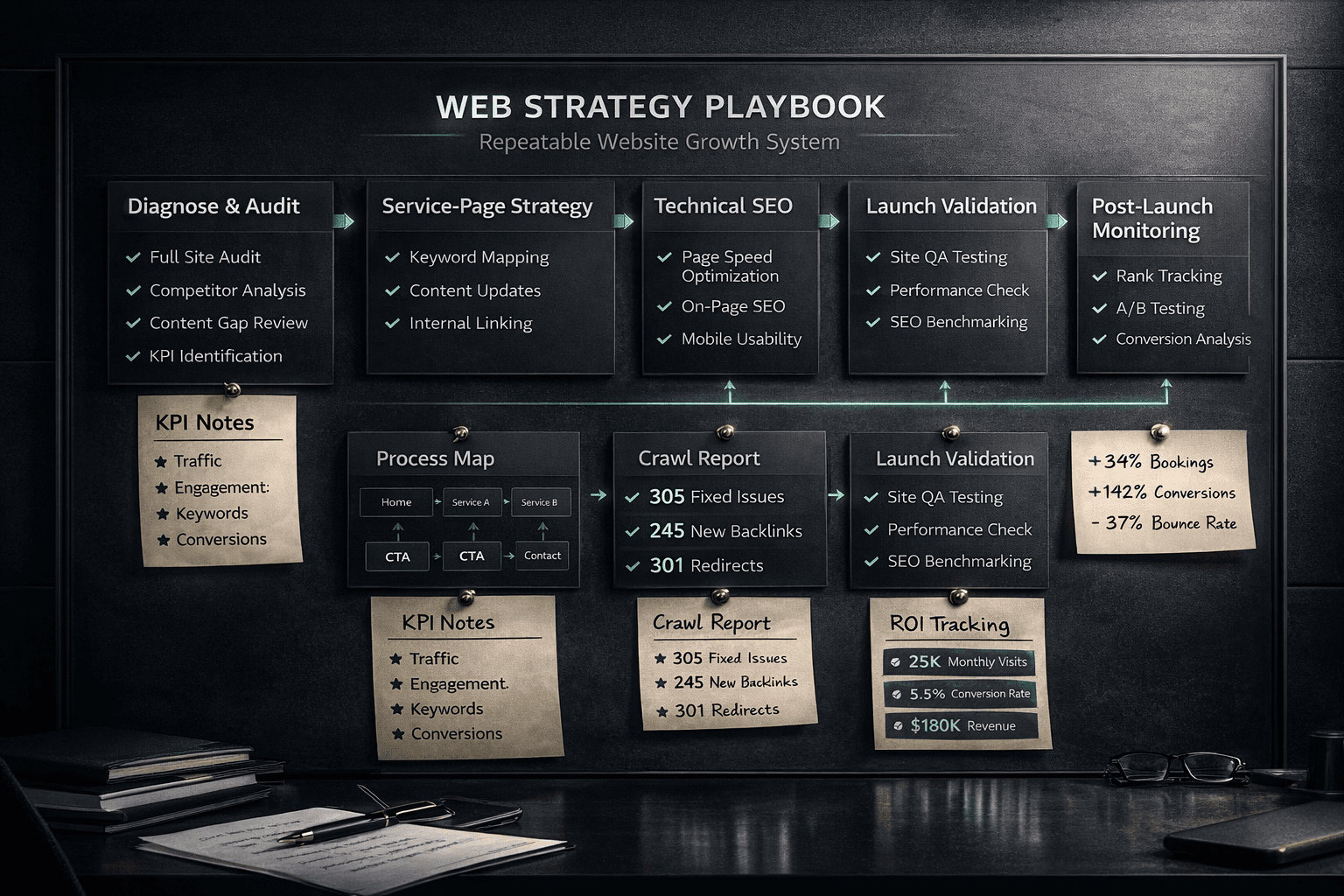
Step 1: Diagnose the real problem
Do not begin with mockups.
Start by asking:
- is this a design problem?
- a speed problem?
- a conversion problem?
- a technical SEO problem?
- a trust problem?
If the diagnosis is unclear, the rebuild will drift.
Step 2: Audit by business value, not noise
Score pages and systems by:
- search opportunity
- conversion importance
- technical risk
- implementation effort
That keeps the roadmap grounded.
Step 3: Clarify your commercial pages first
Before you chase more traffic, make sure important pages can convert the traffic you already have.
That means:
- clearer offer positioning
- stronger objection handling
- cleaner CTA paths
- better trust sequencing
If you want a compact example of that principle, review website design in 48 hours.
Step 4: Build the technical layer to support content discipline
Good architecture is not just about developer preference.
It should make the following easier:
- metadata consistency
- schema consistency
- internal linking
- page-template reuse
- safer launches
Step 5: Protect launch like it protects revenue
Because it does.
Use checklists for:
- redirects
- canonicals
- crawl assets
- analytics
- forms
- mobile QA
Step 6: Monitor outcomes, not only outputs
Do not stop at:
- pages published
- design approved
- build passed
Review:
- speed
- bounce behavior
- rankings and discoverability
- enquiry flow
- booking or lead completion
Step 7: Turn the project into a repeatable system
The biggest long-term win is not one launch.
It is building a process you can reuse across:
- future pages
- future services
- future client projects
That is where the real compounding value appears.
What this means for business owners planning a rebuild
If your current site is underperforming, the lesson is not "use the exact same stack."
The lesson is:
- solve the right problem first
- tie SEO and conversion together
- keep the technical layer disciplined
- make launch operational, not emotional
- build a system you can maintain
That is the difference between a website that looks newer and a website that actually performs better.
If you want help applying that kind of process to your own business, the cleanest starting point on this site is either:
The biggest lesson from the whole J Luxe series
The rebuild worked because the project was never treated as "design first, everything else later."
It was treated as a growth system.
That means:
- strategy informed the roadmap
- SEO informed structure
- conversion informed copy
- architecture protected quality
- launch discipline protected outcomes
That is the full playbook.
And that is why this final post matters.
Without the retrospective, a case study can sound impressive without becoming useful.
The goal here was to make it useful.
Series wrap-up
This completes the 8-part J Luxe rebuild series.
If you are reading this late, the best way to use the series is:
- 1start with Part 1
- 2read through the roadmap in order
- 3save the checklists and playbook sections
- 4apply the sequence to your own rebuild
That is how a case study becomes a system.
FAQ
What was the biggest reason the J Luxe rebuild worked?
The project treated strategy, SEO, conversion, performance, and launch execution as one connected system instead of separate workstreams.
Did the rebuild improve only design, or business performance too?
It improved business-facing outcomes too, including speed, bounce behavior, booking performance, and overall conversion flow clarity.
What was the most dangerous mistake to avoid?
Host-level and launch-week mistakes were among the riskiest because they could affect every important URL or conversion path at once.
Can a small business use this playbook without a large team?
Yes. The principles scale down well because they focus on prioritization, clarity, crawlability, and conversion, not team size.
What is the first thing to do before planning a rebuild?
Run an audit and define the real problem clearly before touching design production.
This final post is not meant to end the conversation.
It is meant to shorten your next rebuild.
If the series helped you think more clearly about SEO, conversion, launch discipline, and maintainability, then it did its job.
Related reads
- J Luxe Medical Aesthetics Case Study
- Launch Week Checklist and First 7 Days (Part 7)
- Why Your Website Is Not Getting Leads
- Website Audit Service
Ready to launch
Launch your website in 48 hours with a done-for-you setup
If this article helped you clarify the next step, the launch offer gives you a mobile-first business website, domain guidance, hosting setup, and a clear CTA flow without dragging the project out.
Chat on WhatsAppWebsite design in 48 hours for businesses that need to go live fast
The 48-hour launch offer is built for businesses that need a clean, mobile-first site live fast with pricing, CTA flow, and basic SEO already handled.
See the done-for-you website launchHosting Support
Need reliable hosting before you build?
Use the hosting offer to start with a cleaner setup and a lower upfront cost.
Related posts
More articles to help you get better rankings and more leads.
Part 7 of the J Luxe rebuild series: the exact website launch checklist, SEO QA routine, analytics checks, and first 7-day monitoring process used to avoid launch-week chaos.
Part 6 of the J Luxe rebuild series: the Next.js architecture decisions that improved performance, crawlability, publishing speed, and long-term maintenance during the rebuild.
Part 3 of the J Luxe series: use this SEO migration checklist to protect organic traffic with 301 redirects, canonical tags, and launch QA.