

J Luxe Website Rebuild Series: 8 Completed Parts on SEO and Conversion
The completed 8-part series on rebuilding jluxemedicalaesthetics.com, covering SEO migration, service page conversion, launch strategy, and Next.js architecture decisions.
Search intent
Informational - first-hand case study and implementation lessons
Primary focus
website rebuild case study series
Built for
Teams that need clearer website decisions before they spend.

Academy article
Victorious
Founder, Web Growth
Published
2026-02-17
Reviewed
2026-07-13
Best next move
Use this guide as the strategy layer, then bring in implementation support for redirects, metadata, content structure, and launch QA.
View SEO Service
Article History
Published: February 17, 2026
Updated: July 13, 2026
Reviewed: July 13, 2026
Editorial Note
The hub links to all eight completed J Luxe rebuild articles and makes no independent ranking, traffic, revenue, or conversion claim.
The series is organized in project order: scope, audit, migration, content, design, architecture, launch, and retrospective.
Author
Founder, Web Growth
Founder-led strategist and developer focused on high-performance websites, conversion systems, and practical growth execution for service and ecommerce businesses.
- Next.js web architecture
- Conversion-focused website strategy
- Technical SEO foundations
- Website performance optimization
- Service-business growth systems
Key Takeaways
- The completed series follows one rebuild from audit and migration planning through launch and retrospective.
- Each part focuses on a distinct decision rather than repeating generic redesign advice.
- Readers can use the series as a sequence or open the part that matches their current project stage.
What You Will Need
- Current website URL and business objective.
- Primary audience and offer clarity notes.
- Baseline performance data (traffic, leads, or sales).
Common Mistakes
- Starting execution before strategic clarity.
- Relying on aesthetics without conversion structure.
- Skipping QA before launch or campaign traffic.
Process Steps
- 1Start with the rebuild decision and audit if the project scope is unclear.
- 2Use the migration, content, design, and architecture parts during implementation.
- 3Use the launch checklist before release.
- 4Finish with the retrospective to separate delivered work from measured outcomes.
Academy lesson
Strategy, implementation notes, and decision support
J Luxe Website Rebuild Series: All 8 Parts

If you are planning a website redesign, this series is for you.
The eight completed posts below break down the full rebuild of J Luxe Medical Aesthetics from strategy to launch.
Not a surface-level redesign.
A real rebuild focused on:
- SEO migration without traffic loss
- local SEO and technical SEO foundations
- high-converting service pages
- premium web design with strong website speed
- Next.js architecture and deployment decisions
- launch checklist execution and post-launch optimization
If you want the final outcome first, read the J Luxe case study. The completed series goes deeper into the process, decisions, mistakes, and reusable playbook.
Why this series matters for website redesign in 2026
Most business owners hear "website redesign" and think visual refresh.
New colors. New layout. New hero section.
But rankings drop.
Leads stay flat.
Mobile performance gets worse.
That is because a successful website redesign is not a design project only. It is a growth project that combines web design, SEO, conversion rate optimization, and technical architecture.
This 8-part series is built for teams that want measurable outcomes:
- better Google rankings
- higher conversion rate from service pages
- faster Core Web Vitals and page load times
- cleaner launch with fewer avoidable mistakes

Who should follow this 8-part rebuild series
This series is written for:
- small business owners planning a website redesign
- medical aesthetics clinics competing in local SEO, including clinics similar to J Luxe Medical Aesthetics
- agencies handling SEO migration during a platform move
- founders choosing between WordPress and a custom Next.js website
- marketers who need service page copy that converts traffic into enquiries
If you are still in early planning, start with the small business website redesign checklist, then come back to this series.
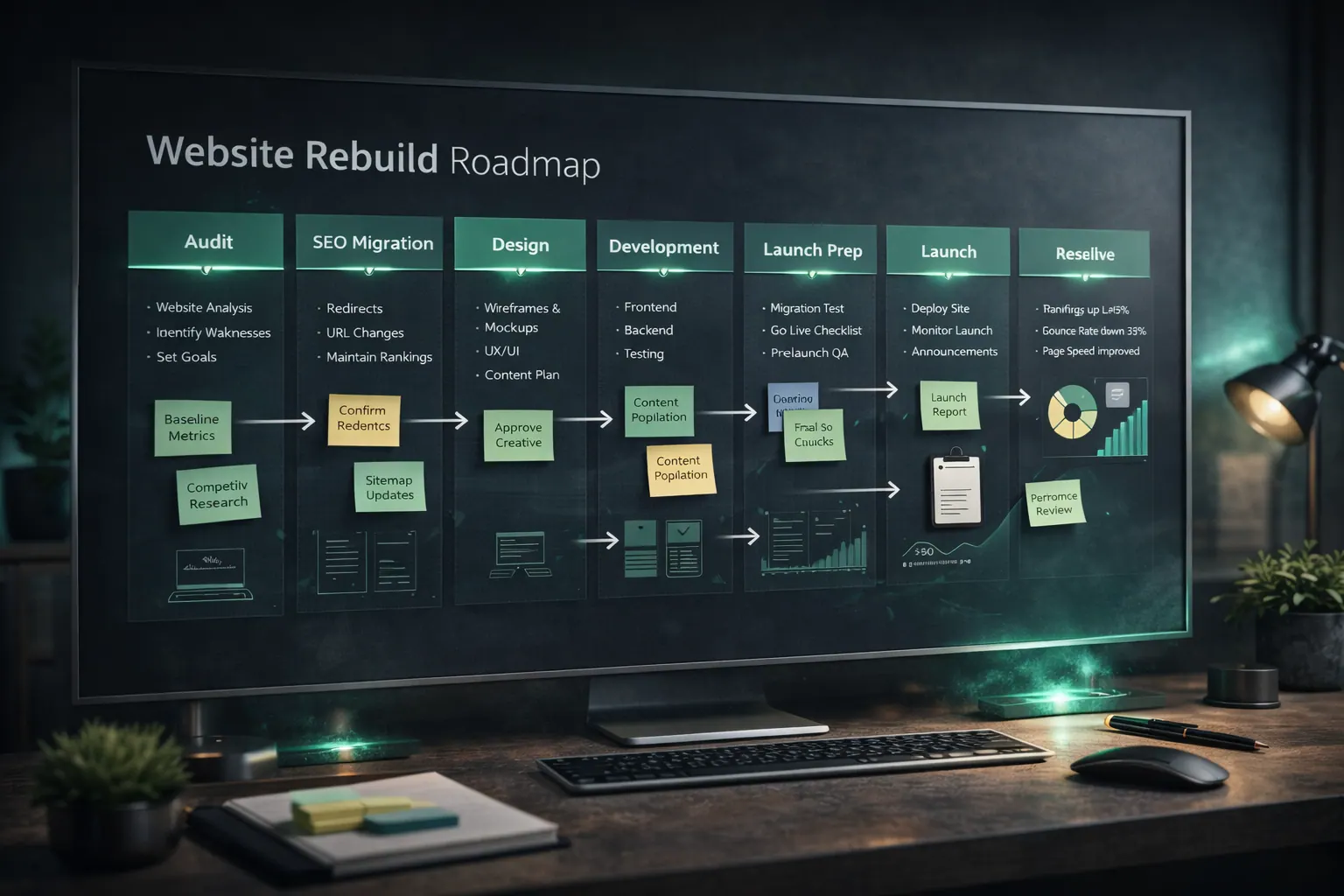
The 8-part roadmap
Below is the full reading order, with a direct link to every published part.
[Part 1: Why We Rebuilt, Not Redesigned](/blog/01-why-we-rebuilt-not-redesigned)
We start with the most important strategic decision.
Why a rebuild instead of a redesign?
This part explains why "redesign" language often causes teams to focus on visuals and ignore business-critical systems like conversion paths, technical SEO, and analytics architecture.
The article documents the decision framework we used to classify the old site as a structural liability, not just a style issue. This includes signs your current stack is blocking growth, when a redesign is enough, and when a full rebuild saves time and budget long-term.
Primary keywords: website redesign, web design, small business website, conversion rate optimization.
[Part 2: The Audit That Created the Roadmap](/blog/02-the-audit-that-created-the-roadmap)
No rebuild should start with mockups.
It should start with an audit.
This part covers the exact audit process used to map technical issues, content gaps, UX friction, and local SEO opportunities before writing a single line of code.
It shows how we scored each page by intent, conversion potential, ranking opportunity, and implementation effort, so every next step had a clear reason.
You will also get the prioritization model we used to avoid wasted work and keep stakeholders aligned.
Primary keywords: website audit, technical SEO audit, local SEO audit, website strategy.
[Part 3: SEO Migration Without Losing Traffic](/blog/03-seo-migration-without-losing-traffic)
SEO migration is where most website redesign projects fail.
This part walks through redirect mapping, canonical control, metadata preservation, internal link transfers, XML sitemap updates, and crawl validation.
It documents how we built a migration checklist to protect rankings during URL changes and prevent "invisible losses" that may only show up weeks later in Google Search Console.
We will also cover common migration mistakes, including broken redirect chains, orphaned service pages, and index bloat after launch.
Primary keywords: SEO migration, website migration SEO, 301 redirects, Google rankings.

[Part 4: Writing Service Pages That Convert](/blog/04-writing-service-pages-that-convert)
Traffic does not matter if service pages do not convert.
This part is focused on copy structure, offer clarity, trust sequencing, and objection handling for local service pages.
It shares the blueprint used for treatment pages, including how to position outcomes, add proof without clutter, and place CTAs based on user intent instead of guesswork.
We will also connect conversion writing to SEO so pages rank and convert together, not in separate silos.
Primary keywords: service pages, conversion rate optimization, landing page copy, website conversion.
[Part 5: Premium Design Without Slow Pages](/blog/05-premium-design-without-slow-pages)
Premium web design should not destroy website speed.
This post covers how we balanced visual quality with performance budgets, especially for image-heavy pages in the medical aesthetics space.
You will learn the design rules we used to avoid heavy layout shifts, oversized assets, and animation overload, while still delivering a luxury brand feel.
It also breaks down practical speed tactics that influence Core Web Vitals and conversion: image strategy, loading priorities, component weight, and mobile-first QA.
Primary keywords: web design, website speed, Core Web Vitals, performance optimization.

[Part 6: Next.js Architecture and Build Decisions](/blog/06-nextjs-architecture-and-build-decisions)
Technology choice is strategy.
This part explains the Next.js architecture decisions behind the rebuild: routing model, component boundaries, content handling, SEO metadata patterns, and deployment workflow.
The goal is not to show off code.
The goal is to show which technical choices reduced long-term maintenance risk and improved performance, crawlability, and publishing speed.
If you are comparing WordPress themes to a custom Next.js website, this post will help you make a more informed tradeoff.
Primary keywords: Next.js, Next.js website, technical SEO, website architecture.
[Part 7: Launch Week Checklist and First 7 Days](/blog/07-launch-week-checklist-and-first-7-days)
Launch week determines whether momentum compounds or collapses.
This post gives the exact launch checklist we used for DNS, redirects, QA, event tracking, indexing checks, and rapid post-launch fixes.
It also covers the first 7-day operating routine: what to monitor daily, which signals matter most, and how to prioritize fixes when the data starts coming in.
If your team wants a calm launch instead of firefighting, this part will be one of the highest-value posts in the series. You can also review the live reference site at jluxemedicalaesthetics.com.
Primary keywords: website launch checklist, SEO checklist, analytics tracking, post-launch optimization.
[Part 8: Outcomes, Mistakes, and Reusable Playbook](/blog/08-results-mistakes-and-reusable-playbook)
The final part is the full retrospective.
What worked.
What failed.
What we would do differently if we rebuilt from zero again.
It documents the outcomes that were available, the most expensive mistakes we caught, and the repeatable playbook you can reuse for your own website redesign or client project. Any metric should be read with the baseline and measurement limits stated in that article.
This is where the series becomes a practical system, not just a case study story.
Primary keywords: website redesign case study, SEO results, conversion results, website growth playbook.
What you will get from every post in the series
Each part will include:
- plain-English strategy for business owners
- technical implementation notes for builders and agencies
- conversion and SEO context so tactics are connected to outcomes
- checklists you can apply to your own project immediately
The series also links these supporting resources published on Web Growth:
- Website launch checklist
- Small business website SEO checklist
- How to make your website load fast
- Homepage structure that converts
The series is complete
All eight parts are published and linked above. Every post is designed to stand alone, but reading them in sequence provides the complete framework for planning, building, launching, and improving a high-performance small business website.
If you run an agency, this will also function as an internal SOP for website redesign and SEO migration work.
How to get the most value from the series
Use this simple approach:
- 1Read Part 1 and Part 2 before making architecture decisions.
- 2Build your migration and launch checklist before design production.
- 3Apply the service page and conversion principles before writing final copy.
- 4Use the results post to refine your own process and avoid known mistakes.
If you are currently rebuilding a live site, bookmark this hub and work through the published parts in order.
FAQ
Is this series only for medical aesthetics websites?
No. The examples come from J Luxe Medical Aesthetics, but the framework applies to any local service business that depends on website traffic and lead generation.
Will you share actual SEO migration steps?
Yes. Part 3 is focused specifically on SEO migration workflow, including redirect planning, metadata transfer, and launch validation.
Is this beginner-friendly or technical?
Both. Each post is written for business owners and marketers first, with technical layers included for developers and agencies.
Why focus so much on website speed and Core Web Vitals?
Because speed affects rankings, user experience, and conversions at the same time. Slow pages leak revenue even when traffic is strong.
Where should I start if my current site is underperforming?
Start with why your website is not getting leads, then review the website redesign checklist before rebuilding.
If you want this process applied to your business, start with the website redesign service or request a quote.
Related reads
- J Luxe Medical Aesthetics Case Study
- Small Business Website Redesign Checklist
- Website Launch Checklist for Small Businesses
Continue learning
FAQ
J Luxe Website Rebuild Series: 8 Completed Parts on SEO and Conversion FAQ
Short answers to the planning, implementation, and decision questions readers usually ask next.
Define the commercial outcome and baseline metrics, then prioritize the highest-impact fixes first.
Use clear scope, measurable goals, and structured QA before and after launch.
Related Reads
Keep building context, not just page views
These Academy guides expand the same implementation path so readers can move from strategy to action without losing momentum.
Pricing
5 min read
Website Redesign Cost in Nigeria: What Affects the Price?
Learn what affects website redesign cost in Nigeria, including page count, content, speed, SEO, mobile experience, integrations, and redesign scope.
Case Study
5 min read
Case Study: Rebuilding J Luxe Medical Aesthetics for Trust, Clarity, and a Stronger London Presence
A practical case study on rebuilding the J Luxe Medical Aesthetics website for a London clinic that needed stronger trust, clearer treatment pages, and a better path to enquiry.
Case Study Series
7 min read
Why We Rebuilt, Not Redesigned: Website Strategy for More Leads and Sales
Part 1 of the J Luxe rebuild series: why a full website rebuild beats a surface redesign when you want better SEO, higher conversion rates, and more sales.
Case Study Series
12 min read
Next.js Architecture and Build Decisions: Technical SEO and Website Maintainability
Part 6 of the J Luxe rebuild series: the Next.js architecture decisions that improved performance, crawlability, publishing speed, and long-term maintenance during the rebuild.
Our articles are written and reviewed in-house using real website launch, redesign, technical SEO, and conversion work. We update posts when our process changes, and we keep the advice aligned with what we actually implement for businesses in Nigeria and remote international markets.
Internal Resource
Planning a higher-stakes SEO move?
Use this guide as the strategy layer, then bring in implementation support for redirects, metadata, content structure, and launch QA.
View SEO Service